Home → Dual-Use Desk Setup Guide → Best Desk Lamp for Gaming
If your eyes feel “tired,” dry, or headache-y after gaming, your lamp is often the problem: wrong placement, wrong beam, or flicker you can’t see. This guide gives you a fast pick + a setup that protects your eyes without ruining contrast in dark games.
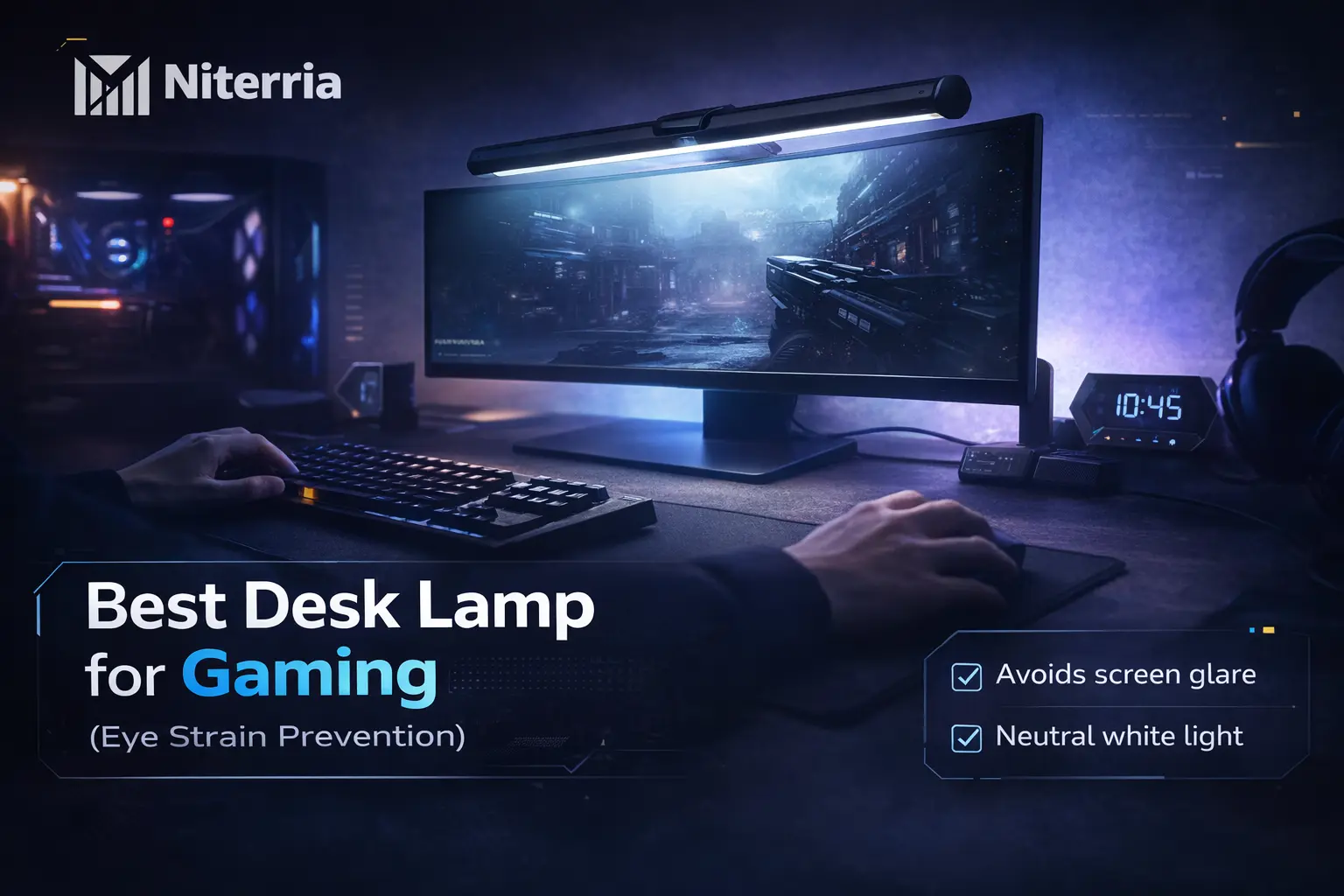
Blunt rule: If you play in a dim room, don’t blast the desk with a normal lamp aimed anywhere near the monitor. Use either (1) a monitor light bar that avoids screen glare, or (2) bias lighting behind the monitor. Everything else is damage control.
Quick Answer (what to buy + what to avoid)
The “best desk lamp for gaming” is the one that gives you clean, flicker-safe light on the desk/keyboard while creating zero screen glare and no direct LEDs in your eyes.
- Buy: adjustable, dimmable light with stable output (no visible shimmer) + controlled beam
- Buy: clamp/arm positioning that keeps the light source out of your sightline
- Buy: neutral white (around 4000–5000K) for competitive sessions; warmer for late-night chill
- Buy: higher color quality (CRI 90+ if possible) so the desk doesn’t look “gray/flat”
- Avoid: bare exposed LEDs in view (instant fatigue + distraction)
- Avoid: cheap dimmers that introduce flicker/shimmer at low brightness
- Skip: “super bright” as a feature—glare control matters more than lumens
- Do: add bias lighting if you game in a dark room (it’s the easiest win)
Table of contents
Best picks (by use case)
Best overall for most gamers: Monitor light bar (asymmetric beam) + optional bias light
Best when you want bright keyboard/mouse visibility without glare on the screen. Ideal for one-desk setups where you work + game on the same station.
Affiliate slot: Check price
Best budget (still sane): Clamp/arm desk lamp with diffused head + stable dimming
Works if you can position it to the side and slightly behind your monitor line, so the source isn’t in your eyes. Budget lamps fail when the dimmer introduces shimmer—test it.
Affiliate slot: Check price
Best upgrade for “dark games” + long sessions: Bias lighting behind the monitor + very low desk light
If your eyes die during night sessions, the fix is usually ambient balance, not more desk brightness. Use bias lighting to reduce harsh contrast between monitor and room.
Read: Bias lighting for gaming (the setup that actually works)
Who should buy: anyone gaming 2+ hours, late-night players, people who also work at the same desk, anyone getting headaches/dry eyes.
Who should skip: if you only play with the room lights on bright and your eyes feel fine—your money is better spent on monitor height/distance and posture.
Fast decision table (choose in 60 seconds)
| If you… | Buy this type | Set it like this | Avoid this |
|---|---|---|---|
| Play in a dim room | Bias light + monitor light bar (or very low desk light) | Keep desk light low; add gentle back glow | Bright lamp pointed toward screen |
| Have screen glare/reflections | Asymmetric-beam monitor light bar | Aim light to desk only; keep beam off display | Bare bulb / exposed LED in front of you |
| Need lighting for keyboard + notes | Clamp/arm lamp with diffused head | Place to the side, slightly behind monitor line | Lamp above/behind your head creating reflections |
| Get headaches after 30–90 min | Stable dimming + glare control first | Moderate brightness; no shimmer at low levels | Cheap dimmer shimmer / strobe-like flicker |
Decision tree (if/then)
Run this in order (stop at the first “YES”):
- Do you game with the room mostly dark? YES → Add bias lighting first, then keep desk lighting low.
- Do you see reflections/glare on the monitor? YES → Use a monitor light bar with a controlled (asymmetric) beam.
- Is the light source visible in your peripheral vision? YES → Reposition (side/behind line) or switch to a diffused head.
- Do you notice shimmer when dimmed? YES → Replace the lamp (dimming quality matters more than brightness).
- Do you need writing/reading light often? YES → Add a side clamp lamp as a second light, not your main blast.
What actually prevents eye strain (not marketing)
1) Glare control beats “more lumens”
Eye fatigue spikes when your visual system keeps adapting between bright sources and dark content. The worst combo is: bright lamp + dark game + reflective screen.
- Goal: light the desk/controls while keeping the screen free from reflections.
- Practical tell: if you can see the lamp reflected on the monitor during dark scenes, your placement/beam is wrong.
2) Flicker (even when you “can’t see it”) is real
Many cheap LEDs flicker more when dimmed. That can show up as headaches, fatigue, and “something feels off.” You don’t need perfect lab specs; you need stable light at the brightness you actually use.
3) Color temperature is a tool, not a religion
- Competitive / focus: neutral white tends to feel clearer (think ~4000–5000K).
- Late-night chill: warmer helps you wind down (but don’t make it so warm the desk looks muddy).
- Best move: get adjustable color temperature and lock in two presets: Focus and Night.
4) Color quality (CRI) affects comfort more than people admit
Higher CRI generally makes the desk look “cleaner” and reduces the weird gray/green cast that makes your eyes work harder. If you’re choosing between fancy features vs CRI 90+, pick the cleaner light.
Related: Monitor distance for gaming (eye strain prevention) and Proper monitor height for gaming.
Setup that works (placement + settings)
Placement rules (90% of results)
- Keep the light source out of your direct sightline. Side placement beats overhead blasting.
- Don’t aim light at the monitor. Aim at keyboard/mousepad/work area only.
- If you use a desk lamp: place it to the left/right and slightly behind the monitor plane.
- If you use a monitor light bar: set it so it lights the desk edge, not the top of the screen.
- If you use bias lighting: keep it gentle—your goal is “ambient balance,” not a neon halo.
Brightness target (simple way)
Your desk should be comfortably visible without forcing your pupils to constantly “re-size” when you look back at the screen. Start dim, then raise brightness until the keyboard is clear—then stop.
Save this: two presets that work for most people
- Focus preset: neutral white, moderate brightness, no glare visible on screen
- Night preset: warmer, lower brightness, bias light on (if you game in the dark)
Want the “whole desk” to stop fighting your body? Start here: Dual-Use Desk Setup Guide and use the Desk Height Calculator to remove posture strain that looks like “eye strain.”
Weighted scoring rubric (rank any lamp in 2 minutes)
Use this to compare products fast (and to write honest affiliate blurbs). Score each 0–5, multiply by weight, then total. Anything below 70/100 is not “best.”
| Criterion | Weight | What “5/5” looks like | Quick test |
|---|---|---|---|
| Glare control | ×6 | No visible reflections on dark scenes; light stays on desk | Open a black screen; look for hotspots/reflections |
| Dimming stability | ×6 | No shimmer at low brightness; feels “steady” | Dim to 10–20%; wave hand in light; watch for strobe |
| Positioning range | ×4 | Can place source out of sightline; stays put | Can you light the desk with the head not in view? |
| Color quality (CRI) | ×3 | CRI 90+ (desk looks “clean,” not sickly) | Compare on white paper; look for green/gray cast |
| Color temperature control | ×2 | Two or more presets you actually use | Can you switch Focus/Night quickly? |
| Desk footprint | ×2 | Clamp/monitor mount saves space | Does it steal mouse space or cable space? |
Soft CTA (monetized): Save this rubric and use it before you buy.
If you want, paste 2–3 lamp links and I’ll score them with this rubric so your “best pick” is defensible.
Symptom → cause → fix matrix
| Symptom | Likely cause | Fix (fast) | Fix (best) |
|---|---|---|---|
| Dry eyes / burning | Too much contrast (dark room + bright screen); staring without blinking | Add gentle ambient light; lower desk brightness | Bias lighting + stable low-level desk light |
| Headache after 30–90 min | Flicker/shimmer at dim settings; glare/reflections | Raise dimmer slightly; reposition to remove reflections | Replace lamp with stable dimming + controlled beam |
| Eyes feel “pulled” / fatigue | Light source in peripheral vision; too bright desk vs dark content | Move lamp out of view; dim down | Monitor light bar + bias light for balance |
| Washed-out blacks / glare in dark games | Lamp reflecting on screen; beam hits display | Turn lamp off during dark content | Bias lighting instead of front lighting |
Common mistakes (that make it worse)
- Buying “brightest”: brightness without glare control is just a headache generator.
- Putting the lamp behind you: classic way to create screen reflections.
- Dimming to super low on a cheap lamp: many introduce shimmer at low levels—test where you actually use it.
- One light for everything: dark games + desk tasks often need different setups (bias + low desk vs brighter desk).
- Ignoring monitor ergonomics: bad height/distance makes you lean in, which increases perceived strain.
Printable checklist (copy/paste)
- Light source not visible in my peripheral vision
- No lamp reflection visible on a black screen
- Stable light at my normal brightness (no shimmer)
- Two presets saved: Focus + Night
- Bias lighting on when gaming in a dim room
- Desk height + monitor height set (so I’m not leaning forward)
Save this: bookmark/pin this checklist so you don’t rebuy the same mistake.
FAQs
Is a monitor light bar better than a desk lamp for gaming?
Usually, yes—because it can light the desk without throwing reflections onto the monitor (if the beam is controlled). A normal desk lamp often creates glare in dark scenes unless positioned carefully.
Will a desk lamp ruin OLED/“true blacks” in dark games?
It can. If the lamp reflects on the screen or raises your room brightness too much, dark content looks washed out. Bias lighting behind the monitor usually gives comfort without nuking contrast.
How do I test for flicker at home?
Dim the lamp to your normal “night” level and wave your fingers quickly under it—if you see a strobe/stepping effect, that’s a bad sign. Also watch for “shimmer” on your desk surface when you move your eyes—replace if it feels unstable.
What color temperature is best for eye strain?
Most people do best with neutral white for focus and warmer for late-night comfort. The “best” is having control and using two presets consistently (Focus vs Night) instead of chasing one magic number.
Should I buy “blue light blocking” lamps?
Don’t let that label decide. Glare control + stable dimming usually matter more for comfort. If you play late, a warmer Night preset and bias lighting are the practical wins.
I have a glossy monitor. What’s the safest lighting choice?
Glossy screens reflect everything, so prioritize glare control. A controlled-beam monitor light bar or bias lighting tends to be easier than fighting a desk lamp’s reflections.
Common mistake: why does my lamp feel “fine” for work but bad for gaming?
Work screens are often bright with light backgrounds, while many games have dark scenes. The same lamp that feels fine for documents can create glare and contrast stress in dark content.
How much should I spend?
Spend enough to get stable dimming and a beam that doesn’t hit the screen. If your current lamp causes glare/flicker headaches, upgrading is cheaper than “powering through” with fatigue every night.
Safety: can a desk lamp being too bright damage my eyes?
Discomfort glare and constant adaptation can absolutely spike strain and headaches. The fix is not fear—it’s control: keep the source out of view, avoid reflections, and stop using “max brightness” as default.
Myth: “More light always reduces eye strain.” True?
False. More light can increase glare and reflections and make dark games look worse. Balanced lighting (desk visibility + ambient support) is the goal, not brightness.
Next steps
- Start with the Dual-Use Desk Setup Guide (the hub for your whole station).
- Bias lighting for gaming: the setup that actually works.
- Monitor distance for gaming (eye strain prevention).
- Proper monitor height for gaming (prevent neck pain).
- Desk Height Calculator (remove the “lean-in” strain multiplier).
Comments
You need to log in to leave a comment.