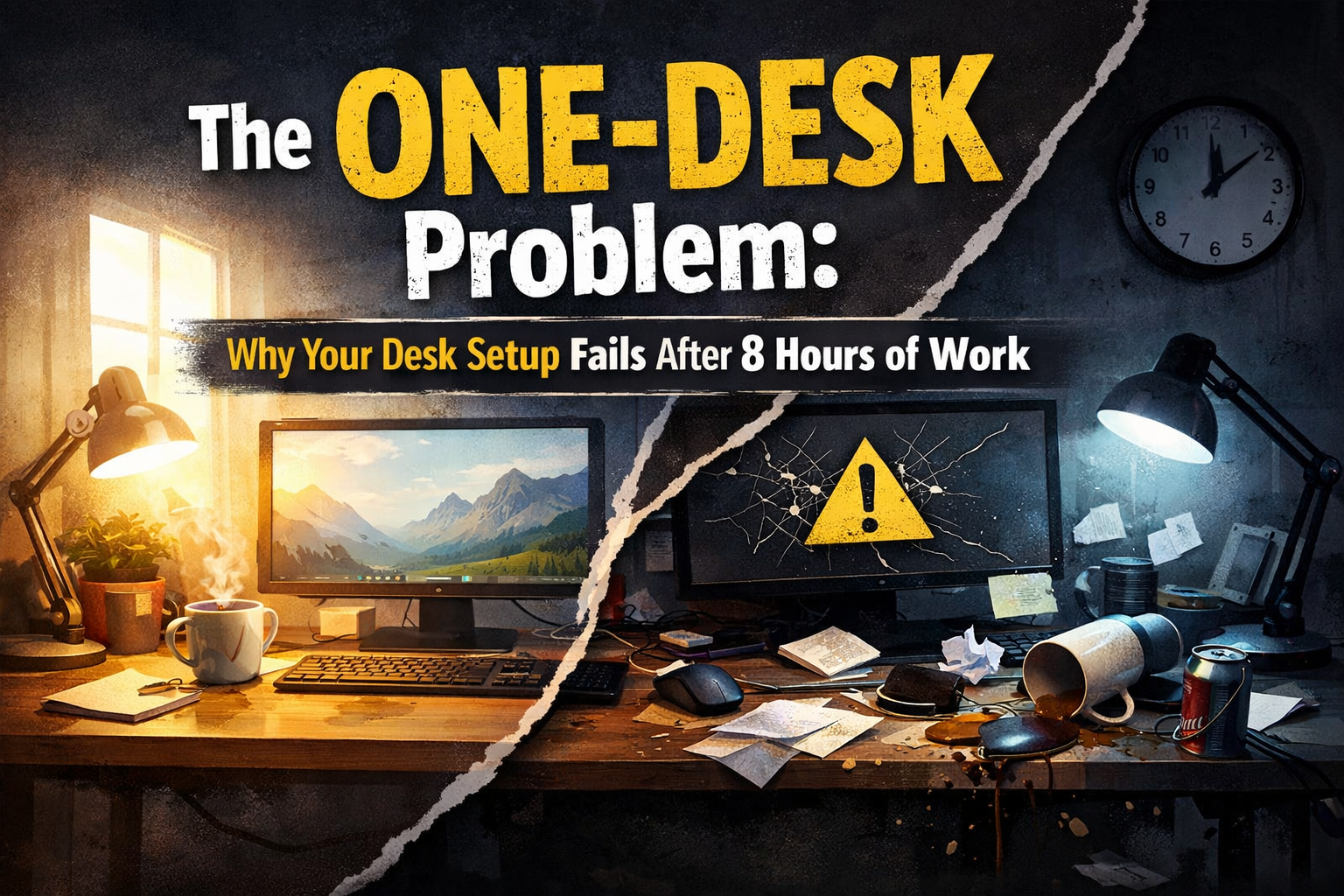
Desk Setup Pain After 8 Hours: Why Most Desks Fail (The One-Desk Problem)
If you experience desk setup pain after 8 hours, you are not imagining things. This problem affects office workers, remote workers, gamers, students, and anyone who spends long hours at a desk. It happens in cheap setups and expensive ergonomic setups alike.
Neck pain, wrist pain, shoulder fatigue, lower back discomfort, eye strain, and mental exhaustion are not random symptoms. They are predictable outcomes of a static desk setup used for long hours.
This article explains what the One-Desk Problem really is, why pain appears after long work hours even in “good” setups, how desk fatigue builds hour by hour, and how to design a desk setup that supports endurance instead of breaking your body down.
Quick Self-Assessment: Is Your Desk Setup Failing?
Answer honestly. If two or more apply, your desk setup is not built for long hours.
- You start leaning forward without noticing after a few hours
- Your wrists bend upward while typing or using the mouse
- Your mouse arm feels tense or unsupported
- Your neck feels stiff after reading or video calls
- Your focus drops before physical pain appears
- You constantly shift in your chair trying to get comfortable
This is not a motivation problem. It is a system problem.
What the One-Desk Problem Really Is
The One-Desk Problem occurs when a single desk configuration is forced to support every task for extended periods without changing height, posture, or reach.
Typing, reading, meetings, planning, creative work, browsing, messaging, and breaks all demand different body positions. A fixed desk does not adapt. Your body does.
When the body adapts to fixed constraints for too long, it creates strain.
Key principle: ergonomics is not about finding one perfect posture. It is about posture rotation over time.
Why Desk Setup Pain Appears After 8 Hours
Desk setup pain is rarely caused by one bad product. It is caused by time and accumulation.
Small posture errors compound silently. A slightly low monitor. A mouse slightly too far away. A desk slightly too high. Each problem alone feels harmless. Together, over eight hours, they overload the body.
This is why people often say:
“I was fine all morning, then suddenly everything hurt.”
Nothing sudden happened. The body simply ran out of compensation.
The 8-Hour Desk Breakdown Timeline
Hour 0–1: Comfort Illusion
- Muscles are fresh
- Posture feels natural
- Minor ergonomic flaws are invisible
Hour 2–3: Silent Compensation
- You lean slightly forward
- Neck flexion increases a few degrees
- Wrists bend subtly
- Shoulders share load unevenly
Hour 4–5: Fatigue Lock-In
- Blood flow drops in stabilizing muscles
- Posture adjustments stop
- Discomfort appears but is ignored
Hour 6–7: Pain Signals
- Neck stiffness or shoulder heaviness
- Wrist and forearm tension
- Reduced focus and slower decisions
Hour 8+: System Failure
- Compensation capacity is exhausted
- Pain becomes persistent
- Productivity collapses
Common Desk Problems and Their Real Causes
| Problem | Primary Cause | Long-Term Risk |
|---|---|---|
| Neck pain | Monitor too low or too close | Chronic stiffness, tension headaches |
| Wrist pain | Desk too high, bent wrist angle | Carpal tunnel syndrome |
| Shoulder fatigue | Mouse positioned too far away | Rotator cuff overload |
| Lower back pain | Static sitting posture | Disc compression, poor circulation |
| Eye strain | Incorrect screen distance or lighting | Headaches, reduced focus |
Why “Perfect Posture” Does Not Exist
Many people try to maintain perfect posture all day. This fails because even correct posture becomes harmful when held without movement.
The human body is designed to shift load between muscles, joints, and tissues. Static posture concentrates load instead of distributing it.
The goal is not perfect posture. The goal is posture variation.
The Biological Reason Desk Setups Fail
Muscles are meant to contract and relax in cycles. Static sitting or standing keeps certain muscles partially contracted for hours.
This restricts blood flow and oxygen delivery. Reduced circulation leads to fatigue, stiffness, and pain.
No chair, desk, or keyboard overrides biology. Only movement restores circulation.
Why Desk Fatigue Is Physical and Mental
Desk setup failure does not stop at physical pain. Mental fatigue is directly linked to physical discomfort.
When the body is under constant low-level stress, the brain diverts resources to monitoring discomfort. This reduces:
- Focus duration
- Working memory
- Decision speed
- Error tolerance
This is why productivity drops before pain peaks.
Single Desk vs Adaptive Desk Setup for Long Hours
| Desk Type | Suitability for Long Hours |
|---|---|
| Static sitting desk | Poor |
| Standing-only desk | Moderate |
| Sit-stand desk | Excellent |
| Hybrid adaptive setup | Best |
Why Most Ergonomic Desk Upgrades Fail
Buying an ergonomic chair does not fix monitor height. Buying a better keyboard does not fix desk height. Wrist rests often hide poor geometry instead of correcting it.
Most ergonomic upgrades fail because they treat symptoms, not the system.
The Real Solution: Build Variability Into Your Desk Setup
The key to an ergonomic desk setup for long hours is variability.
- At least two working heights
- Keyboard and mouse close to the body
- Monitor height that reduces neck flexion
- Ability to alternate between sitting and standing
- Posture changes every 30–45 minutes
Endurance comes from movement, not comfort.
The Long-Term Consequences of Ignoring Desk Setup Pain
Desk setup pain after 8 hours is often treated as temporary. Stretching helps briefly. Painkillers mask symptoms. Then the same load repeats tomorrow.
Daily repetition turns short-term discomfort into chronic pain.
- Chronic neck stiffness
- Persistent wrist and forearm pain
- Shoulder impingement
- Lower back pain that no longer resets overnight
Frequently Asked Questions
Is desk setup pain after 8 hours normal?
It is common, but not normal. It signals insufficient movement and posture variation.
Do I need a sit-stand desk?
Not necessarily, but it is the easiest way to introduce variability.
What is the fastest fix?
Reduce reach, raise monitor height, and trigger movement every 30–45 minutes.
Conclusion: Desk Setup Pain After 8 Hours Is a System Failure
Desk setup pain after 8 hours is the predictable result of a static desk applied to a dynamic body.
If your setup supports movement, posture changes, and recovery, it can support long hours. If it does not, desk setup pain after 8 hours is inevitable.
Design your desk as a system, not a snapshot. Optimize for endurance, not aesthetics.
Comments
You need to log in to leave a comment.